Smoke, Resin, and Oil: A Brief History of Sacred Scent from Sumer to Now
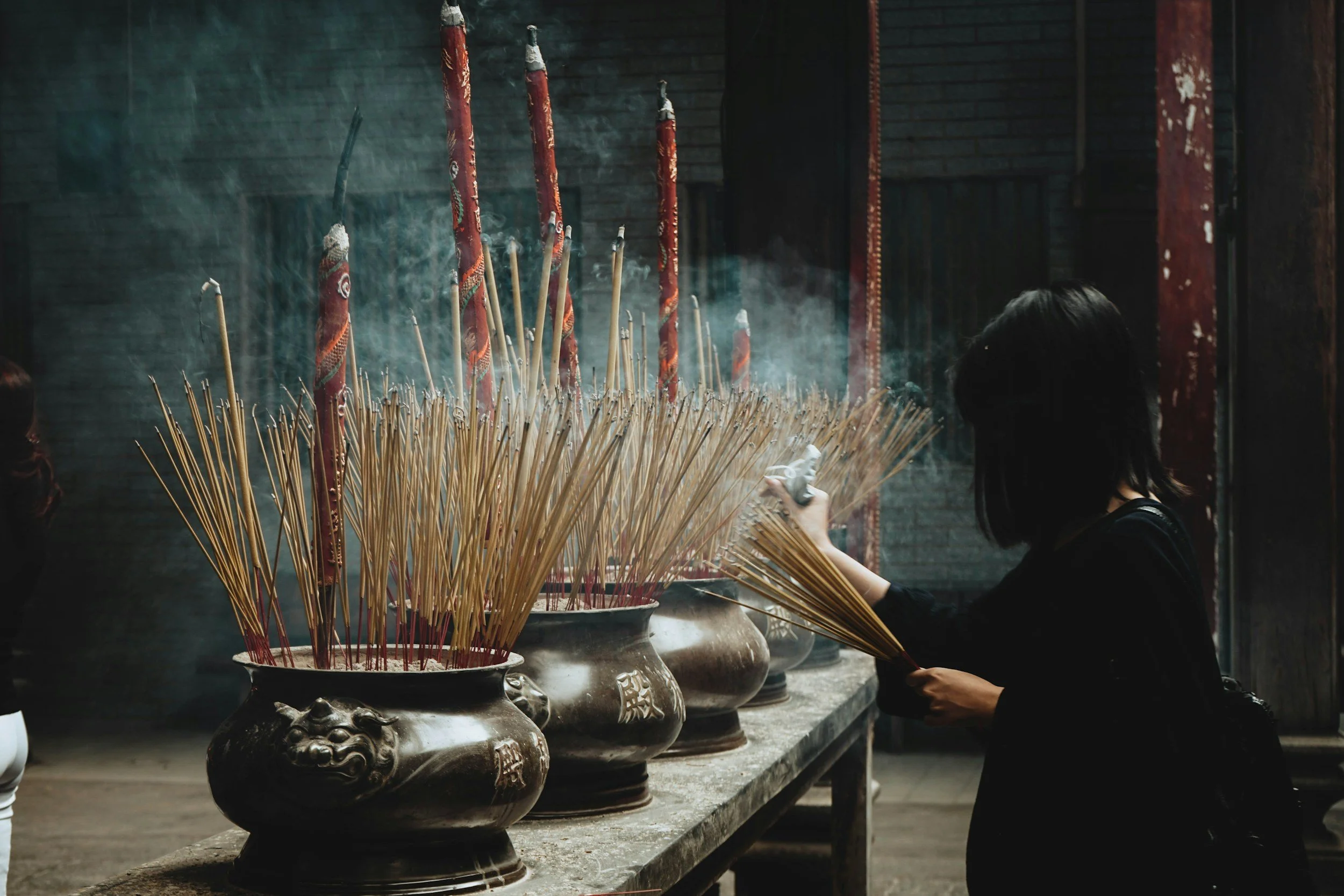
If you want to understand any human civilization, follow the smoke.
Where it rises. What feeds it. Who controls its production. Who gets to stand in it.
Aromatic smoke — incense, resins, sacred fumigation — has been one of the most consistent features of human religious and healing life for as long as we have records. And before records. And probably long before that.
Sumer: Where the Thread Begins (For Us)
The oldest written records we have of aromatic use come from ancient Mesopotamia — Sumer, Babylon, Akkad — the civilizations that gave us writing, law, astronomy, and a deeply sophisticated understanding of plant medicine.
Cuneiform tablets from as early as 3000 BCE record aromatic plants used in ritual and healing. The Sumerians didn't separate these two categories. As will all ancient cultures, disease was understood as spiritual disruption, and healing required both the physical remedy and the ritual to address its cause.
Cedar, juniper, and cypress appear repeatedly — burned in temples, used in purification rites, prescribed for illness. The mashmashu, a class of priestly healer, worked with both plants and incantation. The smell was part of the medicine.
This is the world that many of our Western aromatic traditions descend from. When you trace the lineage forward — through Babylon, into Egypt, into the Hebrew traditions, into Greece, into Rome, into the Western magical inheritance — Sumer is often where the thread begins.
Egypt: Aromatics as Sacred Technology
Ancient Egypt is probably the most cited civilization when it comes to sacred aromatics, and the reverence is earned.
The Egyptians understood scent not as enhancement but as function. Specific aromatic preparations served specific cosmological purposes. Kyphi — a complex blended incense whose formulas were inscribed on the walls of the temples of Edfu and Philae — was burned at sunset to assist the soul's transit between the worlds of day and night. It contained as many as sixteen ingredients: resins, wine-soaked raisins, honey, juniper, various aromatic herbs. And Kyphi wasn’t just a medicine for the temples — it was a household remedy. Every home burned kyphi.
Physicians used aromatics medicinally. Priests used them ceremonially. The Pharaoh was anointed with sacred oils as part of coronation ritual. The dead were embalmed and anointed with preparations that were understood to assist their passage through the Duat — the underworld — and their arrival in the Field of Reeds.
The Egyptians also understood something that neuroscience has only recently confirmed: that smell bypasses the rational mind and speaks directly to something deeper. Their cosmology didn't need brain imaging to know this. It was self-evident in practice.
I study ancient Egyptian aromatics with an Egyptologist, and I want to say clearly: this tradition is far more complex, far more internally consistent, and far more alive than most contemporary references suggest. It deserves serious engagement.
The Ancient Near East and the Incense Road
The aromatic trade routes of the ancient world tell us something important about how seriously these substances were valued.
Frankincense — harvested from Boswellia trees in the Arabian Peninsula and the Horn of Africa — was one of the most traded commodities in the ancient world. The Incense Road stretched from southern Arabia through Petra and Gaza to the Mediterranean. Its operation, over roughly fifteen hundred years, shaped civilizations.
People built kingdoms to control the frankincense trade.
Myrrh traveled similar routes. So did cassia and cinnamon from the East, spikenard from the Himalayas, labdanum from the Mediterranean coast.
These weren't luxury goods, exactly — though they were expensive. They were necessary goods. Necessary for the temples. For the healing rites. For the coronations and the funerals and the daily rituals that maintained the connection between the human and divine worlds.
When the Queen of Sheba brought gifts to Solomon, they included gold and spices. When the Magi followed a star to a manger, they brought frankincense and myrrh alongside gold.
These aromatics didn't travel those distances as accessories. ;)
The Myrraphore Tradition
Somewhere in this intersection of the sacred feminine, anointing practice, and the Levantine aromatic traditions, a particular lineage emerges.
The Myrrhaphore — bearer of myrrh.
In the Gospels, the women who anointed Jesus — at the house of Simon, and again at the tomb — are carrying forward a tradition that predates Christianity by centuries. Anointing the living and the dead. Anointing as a gesture of recognition, of consecration, of love that continues past death.
Mary Magdalene is often associated with this role, though the identity of the anointing woman is theologically contested. What's consistent across the accounts is the act itself: a woman, a precious aromatic, an act that is intimate and radical and understood by those present as significant beyond the gesture.
The practice of anointing — touching another being with scented oil in a ritual context — is one of the oldest and most universal forms of sacred aromatic work. It appears in virtually every tradition we'll explore. It is a technology of healing, of blessing, of marking a threshold.
I find it meaningful that the transmission of this practice, historically, has often lived in women's hands.
Greece, Rome, and the Western Inheritance
The Greek and Roman world inherited aromatic knowledge from Egypt and the Near East and systematized it in characteristic ways.
Greek physicians — Hippocrates, Dioscorides — incorporated aromatics into medical practice. Dioscorides' De Materia Medica, written in the first century CE, catalogued hundreds of plants including aromatic species with detailed notes on their properties and uses. This text remained foundational to European medicine for over a thousand years.
The mystery traditions — Eleusis, Isis, Orphic, later Hermetic and Neoplatonic circles — worked with aromatic substances as part of initiatory practice. Specific incenses were associated with specific deities and states of consciousness. The theurgy (divine-working) of the Neoplatonists included detailed protocols for aromatic fumigations as a means of invoking divine presence.
This material flows into the Western magical inheritance — into alchemy, into Hermeticism, into the Renaissance magi who were trying to recover the whole of ancient knowledge. Into the grimoires. Into the planetary magic of Agrippa and Ficino, who associated specific plants and aromatics with specific celestial bodies.
This is the tradition I often call the Western aromatic inheritance. It is far older and far deeper than most people realize.
Taoism and the East
I want to speak to the Eastern traditions with appropriate humility — my primary training in Chinese aromatic practice is in the Taoist anointing traditions, and I won't pretend to give a comprehensive history of Chinese, Japanese, or Indian aromatic practice in a single paragraph.
What I can say is this:
The Taoist approach to aromatics is among the most sophisticated I have encountered in any tradition. It is rooted in the understanding of qi — vital force — and works with aromatics as a means of moving, clearing, and cultivating that force in the body and the field. Specific aromatic preparations are associated with specific meridians, organs, and elemental correspondences. The work is precise, systematic, and profoundly somatic.
Kōdō — the Japanese way of incense — understands the smelling of incense as a contemplative practice in itself. Not passive enjoyment but active listening. There is even a word for it: kiku, "to listen to incense," rather than kagu, "to smell."
To listen to incense.
That phrase alone contains a whole philosophy.
Ayurvedic aromatherapy in the Indian traditions works with plant medicine in relationship to the three doshas, the seasons, and the individual constitutional picture — an inherently relational and individualized approach that resists the standardization modern aromatherapy often defaults to.
What All of This Means
Here is what strikes me, having spent two decades immersed in these traditions:
The specific cosmologies differ. The deities are different. The language is different. The protocols are different.
But the underlying understanding is remarkably consistent:
Aromatic plants carry intelligence. They act on the body and the soul simultaneously. Certain preparations, used in certain ways, at certain times, by practitioners who understand what they're doing, can facilitate healing, protection, transition, and connection to something larger than ordinary consciousness.
This is convergent wisdom — the same conclusion arrived at independently, across cultures, across millennia.
When I teach sacred aromatics, I am teaching within this lineage.
The Foundations of Sacred Aromatics course opens soon.
It's a foundational course designed to give you real entry into this living tradition — not as a museum piece, but as a living, breathing, applicable practice.
Join the
Juniper Stokes is a botanical perfumer, soul alchemist, intuitive astrologer, and rewilding guide through mythic landscapes of nature, spirit, and the cosmos. For over 25 years, she has been guiding soulful humans back to the heart of who they are and why they're here.


Enjoyed this article? The absolute most wonderful way to say thank you is by sharing it!
ASTROLOGY | RECIPES | REWILDING | SACRED AROMATICS | SHAMANISM | SPIRITUALITY | WELLNESS

A FREE 45-page guide to awaken your inner magic!
Juniper Stokes is a certified depth coach, mythoanimist guide, alchemist, astrologer, and artist.