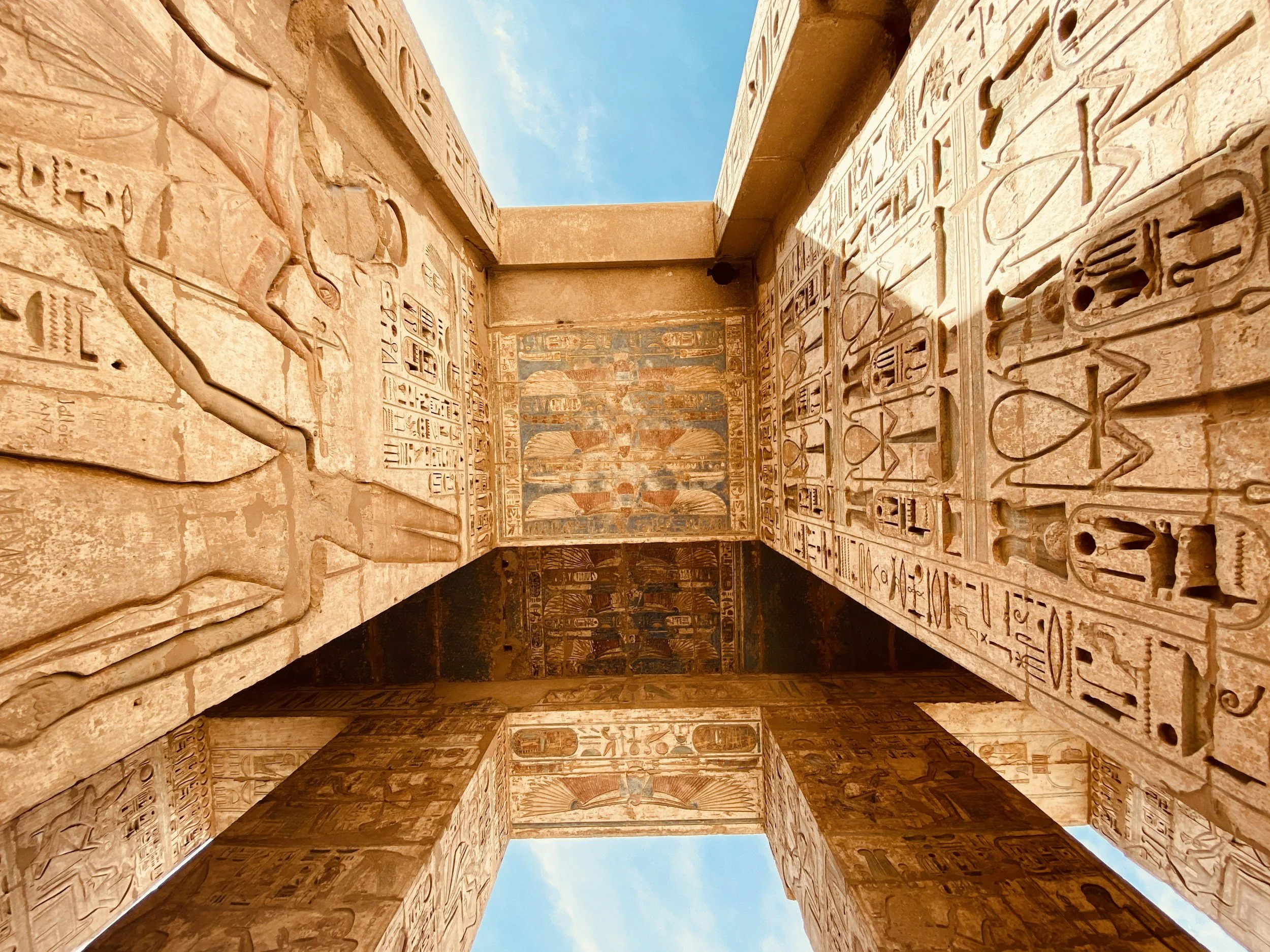
The Egyptian Soul and the Sacred Oils
Ka, ba, akh, and the anointing mysteries of ancient Egypt
An Egyptian temple at dawn announced itself first by smell. Before the images on the walls became clear, myrrh and cedar and the green sweetness of lotus thickened in the cool air. Scent was the medium of the sacred, and oil was a primary carrier of scent — flowers and resins pressed and cooked into fat so they could be kept, offered, and worn on the skin.
Those oils had a purpose, and the purpose was the soul.
To understand what the Egyptians were doing when they anointed a body, a statue, or a living king, we need to know what they thought a person was made of. Their answer is stranger and more beautiful than ours.
The soul as a constellation
The Egyptians didn't picture the soul as one indivisible self. They saw it as a constellation of distinct bodies, each with its own nature and needs, together making a person. The great journey of the Book of Coming Forth by Day is, underneath everything, the story of one self becoming another.
Khat — the body
The khat is the flesh and form the Egyptians took such care to preserve. The body was kept, honored, and made ready as an essential part of the journey. This is our reminder that matter is the ground we work from — the sacred begins in the flesh.
Ka — the vital double
The ka is the life-force, kindled in us at the first breath. The Egyptians pictured the god Khnum shaping each person's ka on his potter's wheel alongside the body — a second self, a body double in a way, holding the pattern of a life. The ka is why the dead were brought offerings of bread and beer, and why "to die" could be spoken softly as "to go to one's ka."
This is the self we have to feed, with food and also with beauty, rest, and devotion — whatever keeps the life-force lit. It's worth asking: what have I been feeding my ka?
Symbol: two upraised arms.
Ba — the moving self
The ba is often translated "soul," though it's closer to the signature of who someone is — the personality, the particular way of being alive. It's the part that moves freely between worlds. The Egyptians drew the ba as a bird with a human head, flying out from the tomb by day and returning at night.
This is the self that comes forth by day, the phrase that gives the Book of the Dead its name. The ba is our freedom and our uniqueness, never meant to stay in the dark.
Symbol: a bird with a human head.
Ib — the heart
For the Egyptians, the heart rather than the head was the seat of thought, feeling, memory, conscience, and will. It was the one part that knew a person completely, and the only organ left inside the body during mummification, because it would be needed.
The ib was set on the scale against the feather of Ma'at. The heart cannot lie. It holds the truth of a life.
Symbol: the hieroglyph for a heart-shaped vase.
Ren — the true name
The ren is the true name, spoken over us at the beginning and, the Egyptians believed, among the most enduring parts of a person. To speak a name kept its owner alive; to chisel a name off a monument was an attempt to unmake the soul itself.
A soul who passed the judgment was declared maa kheru — true of voice — the name vindicated, now spoken among the gods. To live in Ma'at is, in part, to become someone whose name can be spoken in truth.
Sheut — the shadow
The sheut is the shadow, always with us. The Egyptians understood it as protective, holding part of a person's essence and power, though dangerous if misused.
Lightening the heart has never meant banishing the shadow. To be maa kheru is to be in right relationship with darkness rather than free of it. The shadow stays — present, honored, no longer tipping the scale.
Symbol: a silhouette.
Akh — the shining one
The akh is where all of this is headed. It's the transfigured spirit — luminous, radiant, effective — that a person becomes once the parts of the soul are gathered and vindicated, once the ba and ka are joined and the heart is found light.
The word itself means to shine. The blessed dead were the akhu, the shining ones, at home among the stars that never set.
The Egyptians named other subtle bodies too — the sahu, a glorified spiritual form, and the sekhem, one's vital power — and the number of parts shifts from text to text and age to age. The list matters less than the truth underneath: we are many, and the many are meant to become one.
A soul had a scent
Here is where the oils come in.
The gods knew a worthy person by fragrance. In the Ani Papyrus, Anubis brings the deceased before the forty-two judges and vouches for him: when he smells this soul's odor, he says, it is like the odor of one of the gods. Worthiness had a smell.
So the oils were never decorative. Anointing was the technology by which a soul was made fit to be recognized.
The seven sacred oils
By the time of the Pyramid Texts, the Egyptians already kept a fixed set of seven sacred oils, expanded in later periods. Their names were carved onto offering tablets of alabaster, each oil given its own small hollow for a drop. The oldest complete set we have was buried with Queen Hetepheres, mother of Khufu.
The oils were prepared in the temple laboratories, consecrated with the words of Thoth, and used to anoint the dead, the statues of the gods, and the living king alike.
Opening of the Mouth
These same oils appear in the Opening of the Mouth ceremony, the rite that returned breath and sense to the dead so they could eat, speak, and smell again in the next world. Myrrh unguent was named explicitly among the items required to perform it.
Anointing the forehead was the moment of transfiguration — the touch that turned a body into an akh.
To be anointed was to be made divine
The Egyptologist Alison Roberts traces this through the great New Year ritual, where the pharaoh was anointed to be remade as a god and the cosmos renewed along with him. In her reading, the anointing mysteries were feminine at their heart: the goddess, and the queen who embodied her, was the one who anointed, and her touch conferred the divinity. Hathor's fragrance, myrrh especially, was the sign of the goddess's presence.
Coming forth by day
An alchemy hides in all of this.
The passage from ba to akh — from the moving, personal self to the shining, transfigured one — was more than a map of the afterlife. As scholars like Jeremy Naydler read these texts, they describe an experience meant for the living: an initiation into becoming divine while still breathing, still walking the earth. The book is called Coming Forth by Day, not Coming Forth After Death.
None of it waits for death. It's here for us now.
Our own anointing
Scent slips past the thinking mind and reaches straight into memory, emotion, and the body. Fragrance shifts our consciousness into a state more capable of receiving divine wisdom. The Egyptians made a sacred technology of this, and when we anoint, we are working the same way — inviting the plant to change us through the skin and the breath.
With each oil, we attune to the fragrance of the soul, teaching our constellation of selves to hold the scent of Ma'at.
A contemplation
Take a few slow breaths and let your awareness settle into the body. Pause with the oil in your hand, bring it to your nose, and breathe it in fully. Then anoint, and sit with a question or two.
Which of these selves have I tended well, and which have I let fall quiet?
What is my ka hungry for?
What am I asking this oil to help transfigure in me?
If scent is a language, what is this fragrance saying to me today?
What would it feel like to speak my own name in truth — maa kheru?
Rest a moment with the fragrance on your skin before you rise.
We are each a constellation. May these days gather our many lights and teach them to shine as one.
This material accompanies Cultivating a Featherlight Heart, a 42-day journey with the ideals of Ma'at, and the sacred anointing oils I’ve specially made to accompany the program.


Enjoyed this article? The absolute most wonderful way to say thank you is by sharing it!
You might also like:
A 10 year old meets Thoth and the journey begins
Lion’s Gate Portal 8/8: Ancient Origins, Portal Openers, and the Key to Manifestation
The Heliacal Rise of Sirius, the Five Sacred Epagomenal Days, and the Egyptian New Year
Ancient Egyptian Scarabs: 6 Reasons This Beetle is Pure Magic
Healing with the Goddess Ma'at
The Alchemy of Spiritual Perfume: A Complete Guide to Sacred Aromatics
ASTROLOGY | RECIPES | REWILDING | SACRED AROMATICS | SHAMANISM | SPIRITUALITY | WELLNESS

A FREE 45-page guide to awaken your inner magic!

Juniper Stokes is a certified depth coach, mythoanimist guide, alchemist, astrologer, and artist.